Feeds:
Posts
Comments

Archive for the ‘Non-Music’ Category

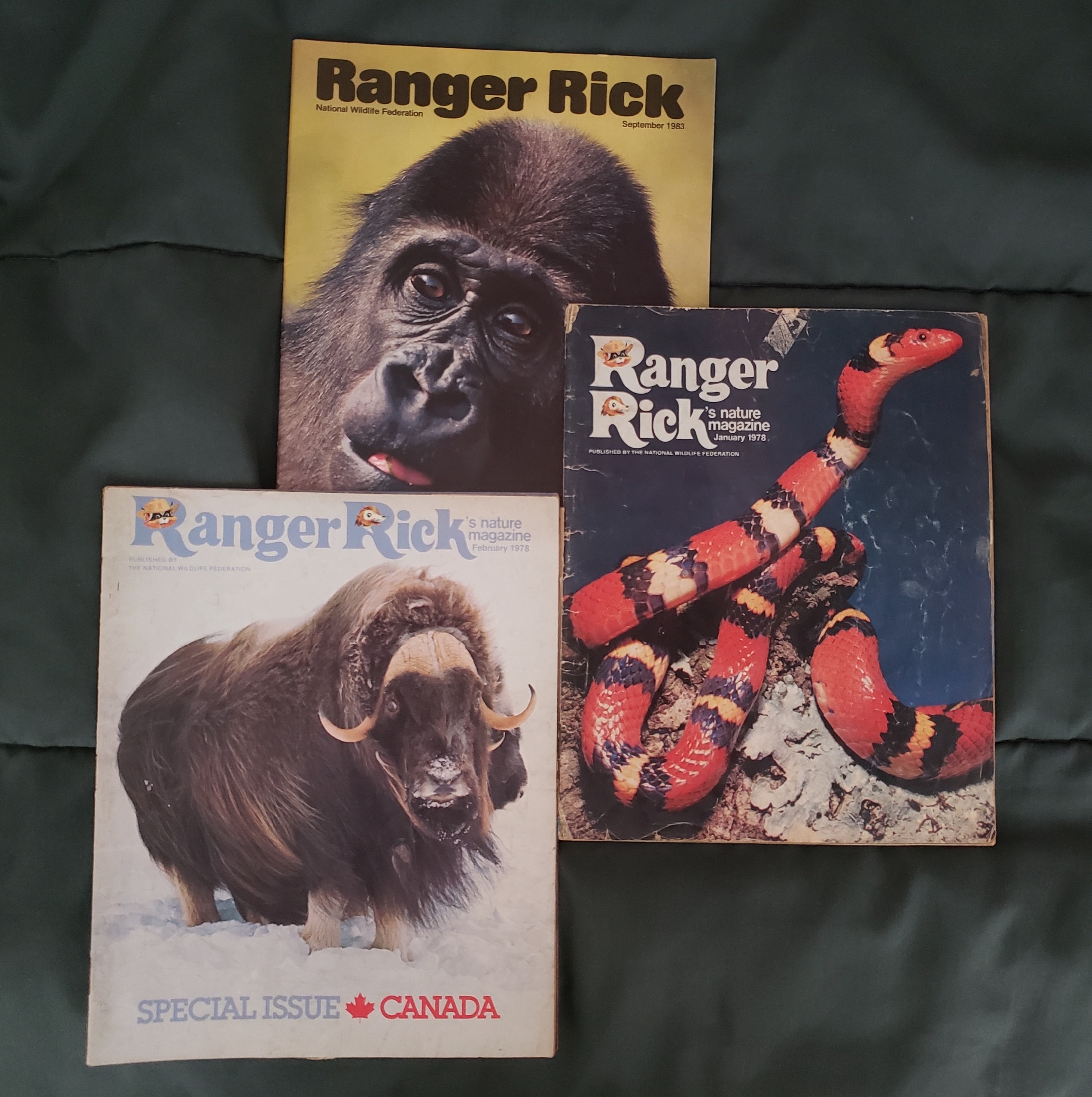
Who remembers the National Wildlife Federation’s Ranger Rick?

Three of my Ranger Ricks!

Although I’m not ready to start filling it with squirrel and nonprofit ideas, I do plan on reading each of the above three issues and offering my reactions to them on my in embryo Squirrel of the Week blog.

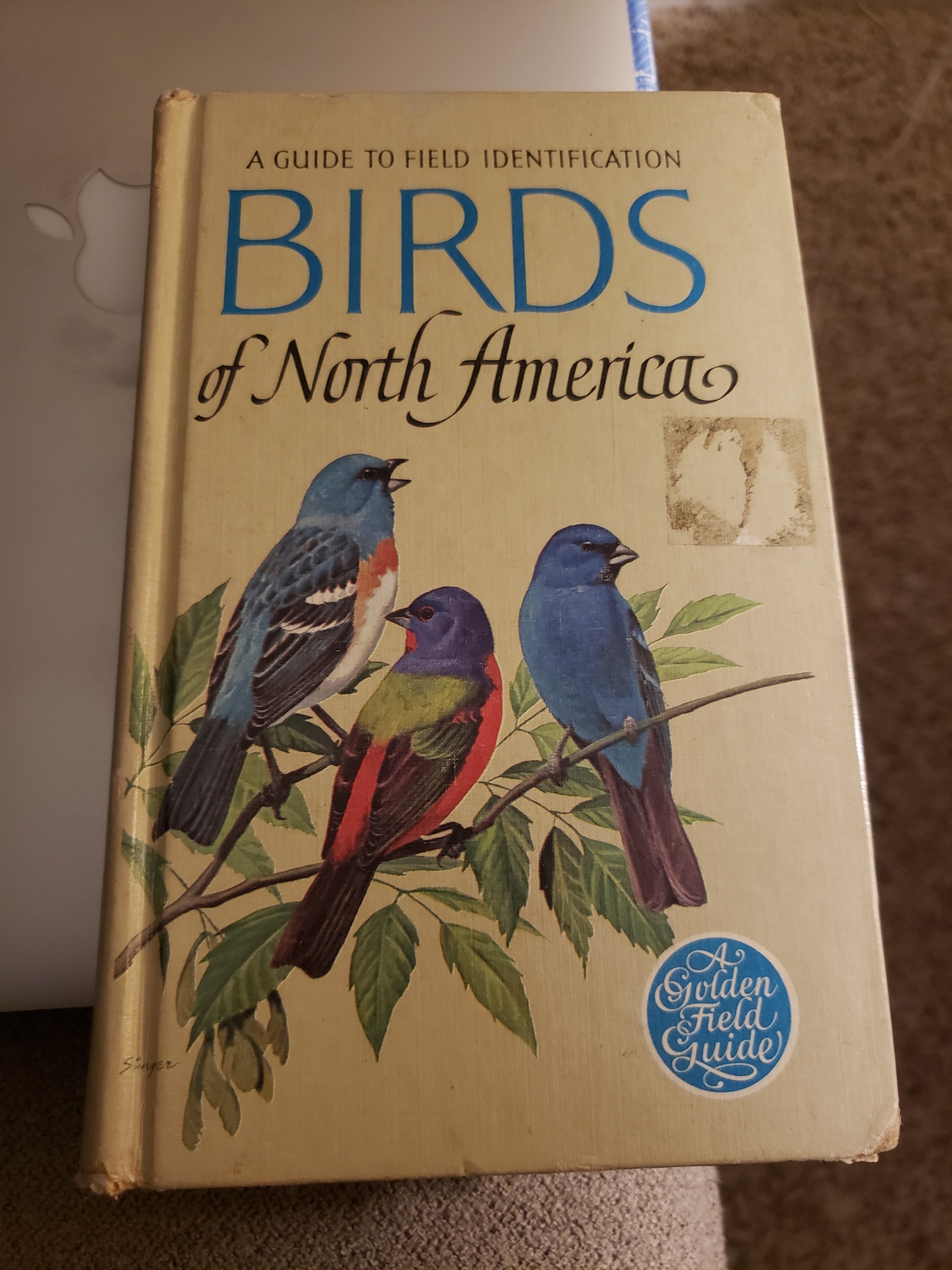
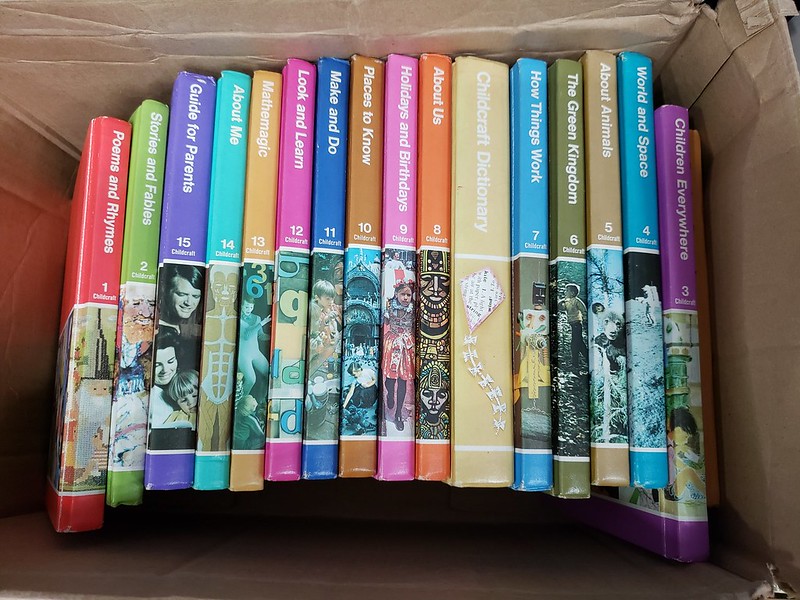
So, keep your eyes open for that, and consider subscribing to both blogs, by using the sign up on the upper right of each page. I’ll get reading, and for now leave you with some images of other important books in my upbringing that are also likely to appear here again.

Read Full Post »

I used to read Louis MacNeice in my birthday month, tracking his published poems with my age. I gave it up several years ago, but decided this year to catch up, starting with reviewing some poems MacNeice published in his late 30s and early 40s. In a couple of years, we’ll meet in age again as I catch up.

I’m not sure why I stopped with the annual reading of him. Maybe I got bored; more likely poetryboth writing and reading itwas lost in pain to me. But now maybe I have found the strength of sane return in my late 40s while MacNeice found it in his late 20s. 

Before I turned to catch up with my reading with the poem “Plurality,” I took up Louis MacNeice’s pinnacle, “Sunlight on the Garden” and “June Thunder,” poems I remember from the old Norton anthology, my Oxford anthology, and now my worn Faber Collected Poems.

Set amid some poems with a similar theme, this is MacNeice at age 29 or 30, ushering in a new era of his life, with looks to nostalgia, loneliness, and how youth experience the world, turning to experience the world in a new phase of maturity. “Taken for Granted” and “The Brandy Glass,” are two other excellent poems in his 1938 collection, The Earth Compels, capped off with “Bagpipe Music.” (I notice I pencilled in that 1939 was his annus mirabilis, but 1937 makes a good case at quick glance.)

“Sunlight on the Garden” has the hard coziness, sunlight on pavement, that characterize this time in MacNeice’s poetry. Read it on renowned poet W. S. Merwin’s (palm tree forest) conservancy page. It’s a poem of maturity, a reconciliation to death’s more tangible reality, a relishing of beauty through a new lens: “And not expecting pardon, Hardened in heart anew, But glad to have sat under / Thunder and rain with you.”

June Thunder” too, a return to a place not in thought alone. He returns to the old fields, his old room, a “cleansing downpour / Breaking the blossoms of our overdated fantasies.” But in this poem he is alone, not sharing the garden with someone: “If only now you would come I should be happy / Now if now only.”  

It’s wonderful to experience these poems again, reaching a deeper delight in them at an age much more advanced than MacNeice’s when he wrote them. And I have not experienced a good thunderstorm in some time, either, maybe because the seed took hold that being out in thunderstorms might get me struck dead by lightning, plus the fact there is no one to run around with in the weather with anymore. (More here.

Here’s a lesser-known poem of the same time, directly following “June Thunder” in my Faber book, a fading echo of the previous poem:


The heated minutes

The heated minutes climb

The anxious hill,

The tills fill up with cash,

The tiny hammers chime

The bells of good and ill,

And the world piles with ash

From fingers killing time.


If you were only here

Among these rocks,

I should not feel the dull

The taut and ticking fear

That hides in all the clocks

And creeps inside the skull

If you were here, my dear.


I usually don’t have anyone specific in mind anymore to think of as “my dear,” but the sentiment still exists. I wrote a short story based on “June Thunder”; I wonder if I have the daring to turn to look at it.


Read Full Post »

My reading calendar has been consciously in place longer than my music one, which is still driven only by feeling until maybe my last post, where I codified my feelings, for better or for worse.

I’m not sure how it started, but it must have been feelings like my music ones, and then a decade or so ago I looked at all the books on my shelf and decided to enjoy the carousel that was my mind, for once. Some of these monthly selections arose very naturally, long before I was conscious of anything, some came when I saw I had a mess of worthy books that were not being read. 

You might wonder where the nature books are; well they have been declared an ongoing concern, with readings in that vein taken up throughout the seasons. 

January

Russian, or Continental, fiction. This clearly arose from my working world days, taking the train to work in bitter weather and enjoying soaking up every phantasmagoric page of bedraggled, disgruntled, gauche civil servant fiction.

February

Brit hist, Vicky, Boney, Scots, &c. This started in an era of a lot of reading of the eras and lives of Napoleon and Queen Victoria, branching into general British history, including and especially the more alienated nations, plus the rest of Europe. The 19th century doesn’t loom as large as it once did, although it is still immense.

March

Presidential bios/U.S. history. Having collected two sets of presidential biographies, this seemed requisite. One president a year in at least one short book, and history related to his era.

April

International history (non-U.S., non-European). Adventures in my smattering of history books set in Asia, Africa, South America, Caribbean, Central America, the Middle East, the Pacific, the Arctic, Siberia &c.

May

Zola’s Rougon-Macquart series. In order written, as series should be read. We’ll see if I live long enough. I have a couple of translations of some of the books and have enjoyed comparing them to the originals when selecting.

June

Children’s fiction, Very Short Introductions. Summer away from school, why not read the old favorites? I have pairs of Oxford’s “Very Short Introductions” books and this an opportune time for summer study fun!

July

Thick novel. Sometimes not so thick. Lazy, hazy, crazy days of summer.

August

Music, art. A small group of classical music books (scores, lives), plus a lot of books about 19th-centure painters, mostly. 

September

Greek, Classical World, ancient, Louis MacNeice. A return to my heady first year of college where I delightedly delved into Classics. Greek Epics, plays, and poems, maybe history and art, what have you. Other ancients have been added to the mix. I began reading my collected Louis MacNeice (born on a date near mine) poems whose publication dates matched my age. I abandoned this habit several years ago, but am rectifying that this catch-up year.

October

Poetry, ghost stories, Irving-Chew. More loving return to schooldays, and what other month could be most poetic of the year, Keats’ birth month? On his birthday I read Washington Irving’s “Legend of Sleepy Hollow” annually for a decade or so. This gave way to Ruth Chew books about witches and magic. I also read a biography of A. C. Swinburne this month a while back. I never liked his poetry, but dug his life, and decided he’d make the ideal Hallowe’en persona if I ever put a lot of effort into ever wearing a costume again. 

November

Philosophy, religion. November weather must make me think, or want to. Paving the way for celebration and change?

December

Mystery, comics, roleplaying game rules/worlds. This started with reading a volume of Conan Doyle’s Sherlock Holmes books per December along with Wodehouse or something akin. Now I have some comic book collections and roleplaying game guides lying around, so might add those. We’ll see.  

Read Full Post »
I

As I look at my lists⁠—lists of favorite books, games, favorite movies and shows, movies and shows to see, careers, what to do today, what I want to do with my life in writing, nature studies, and learning the didgeridoo⁠—I sometimes think of what has been lost, how life was long before these lists really took hold and established what seems to be a permanence.

When I was young, I didn’t think about or try to plan which way my mind would go, and accomplished seemingly all sorts of things, including a few fun lists, of course, from the World Almanac, an Estes model rocket catalogue, or whatever else was in my hands; but they were never lists that pressured me into the future. You never know, and more importantly it never seems to matter, which way the mind will go when untutored, unstudied, left to its own devices, un-self-conscious. What projects, pursuits, and pitfalls it will fall into and just as easily slip out of. If there is an inherent energy, a lot will be done, possibly even accomplished.

A couple of writers come to mind who wrote in this way⁠—Lord Byron and H.G. Wells. Byron was an endless fount of poetry for a lot of his life, and was tired by his editors, but kept composing and wasn’t given to too much polishing. Wells pursued his writing objectives, completed them, and then moved on. He did not dwell upon his novels in the aesthetic revision sense. John Keats could sit under a plum tree, scribble up an ode and leave it thrust into some books, to be scooped up by Charles Armitage Brown and later published as a masterpiece.

There is something to working randomly that the burden of age, conscience, time pressures, or simple change has robbed me of. But, contrariwise, there is something to that final polishing and publishing that takes conscientiousness and follow thru. The fine art of acting in the moment and then taking the steps to preserve what is worthwhile out of it.

II

This tidbit came to mind amidst this crisis and all of this almost lecherous turning out of doors and socializing in larger and larger groups: “I am perfectly fine with many things being put on hold. When you’re on crutches you can’t play soccer for a while⁠—do something else. I don’t know why many in our society don’t draw that same conclusion.” My married, but otherwise bordering-on-hermit friend concurred, adding a few choice words about sheep, well here they are: “Maybe I’m full of myself but I think many in our society don’t have the capacity to draw the same conclusion. People work their jobs, watch television. They aren’t critical thinkers. They aren’t learners. They’re sheep. Sitting at home all day, they don’t know what to do with themselves. When you have a narrow identity and that identity is taken away, they don’t see anything other than getting that identity back. I don’t know. It’s a theory.”

III

And then this exercise from an old junior high friend who posted the idea online: favorite songs of yours as a kid, from tenderest babe up to early junior high. I copped out a bit on this, not digging into the deeper reaches of my memory. Maybe I was a little afraid to probe into the pre- and early elementary school daze, but what I came up with was something at least. Just way too many songs passing into my brain in the 70s. I fondly remember playing the song “I Can’t Stand It” from a neighbor’s Donny Osmond album at speed 78, ca. 1977, and I know that wasn’t because we liked the song. 

So, restricting myself to early ’45s I bought that I still have and sometimes play: “Come on Eileen” Dexy’s Midnight Runners, “Rock of Ages” Def Leppard, “Cum on Feel the Noize” Quiet Riot, “Electric Avenue” Eddy Grant, “Abracadabra” Steve Miller Band, “Even the Nights Are Better” Air Supply, “One Thing Leads to Another” The Fixx, “The Safety Dance” Men Without Hats, “Keep Feelin’ Fascination” The Human League, “I Feel for You” Chaka Khan, “Stray Cat Strut” The Stray Cats, “Puttin’ on the Ritz” Taco, “Total Eclipse of the Heart” Bonnie Tyler. Not so bad, actually!

Read Full Post »

One of the cooler conservation organizations out there, the Center for Biological Diversity, sent me a postcard with a beautiful red fox looking at me with the poem “Keeping Quiet” beside. It’s by Pablo Neruda and I hope you’ll read it and mull it over, maybe even recognize it as your natural state, one that seems to have been forced upon many people these days who are so used to unceasing hustling. Without going on about it, I had never read this poem before, and it perfectly reflects the way to combat this gospel of profit margin, of anthropocentric growth, of getting ahead that so pervades human endeavor.

Speaking of celebrating the profitless, have you voted in the Signac puzzle piece poll yet?

I’ve been spending some more time with Divine Discontent by Sixpence None The Richer, listening more closely and associations that were vague now register.

There is the Crowded House cover, track 4, and one that brings to mind Alanis Morissette (5), early late Beatles (10), Bacharach or Alpert (11), and not sure, but someone (12), all delivered with Leigh Nash’s rich vocals and Matt Slocum’s rich orchestration and deft (along with Sean Kelly) guitar playing.

As usual, the best songs are the ones penned by Slocum alone. There’s even a developing “hat trick,” as I call a wonderful succession of three songs that lead off the somber festivities: “Breathe Your Name,” “Tonight,” and “Down and Out of Time.” This last is my favorite song at this point, and one Nash also contributed to.

Slocum’s songwriting remains at the high level of their big hit album, and his vulnerability and confessional knowledge of his own weaknesses remains as well. “I’ve Been Waiting” hooks you in and takes the breath away. “Down and Out of Time” captures some of the song that began their previous album“We Have Forgotten” has this lashing out: “don’t go, I’ll shoot you down.” “Down and Out of Time” says, “I aim my cannon at you ready or not / You’re gonna feel my pain like it or not.”

There’s no nicer song to sing along with. And it’s perfect for this time when so much is grounded and, despite all the pain for so many, there is much to be found in exactly thatbeing grounded. “Perhaps this earth can teach us / as when everything seems dead / and later proves to be alive.”

Read Full Post »

My last post celebrated Paul Signac’s glorious Blessing of the Tuna Fleet at Groix, a puzzle of which I completed not long ago, however long ago it feels.

One thing that made this experience special were the pieces, jigsawed into many shapes and betraying the minute detail that Signac lavished on his work. You can see details in my last post, and here are a few isolated shots that give a small feeling of what it was like as I worked on the puzzle (click to enlarge):

Click the image on the left and take a close look. Which piece do you find the most fascinating? The one that heightens your respect for Signac’s skill? Vote now!

Yes, this post was named after this song by Peter & Gordon. It has one of my favorite openings ever, and apparently was banned for a time after 9/11. We’re not the only decade that knows strange times.


Read Full Post »

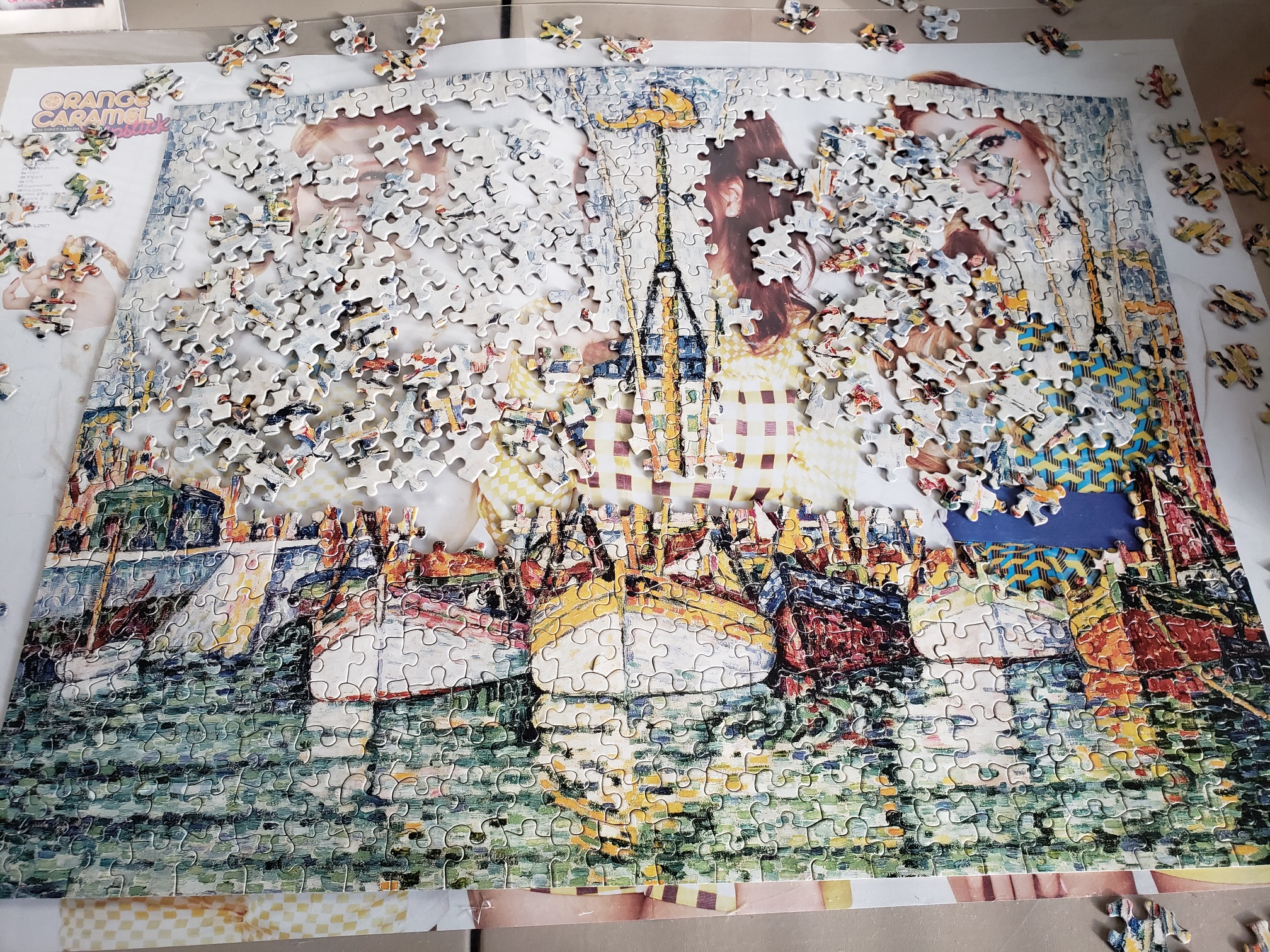
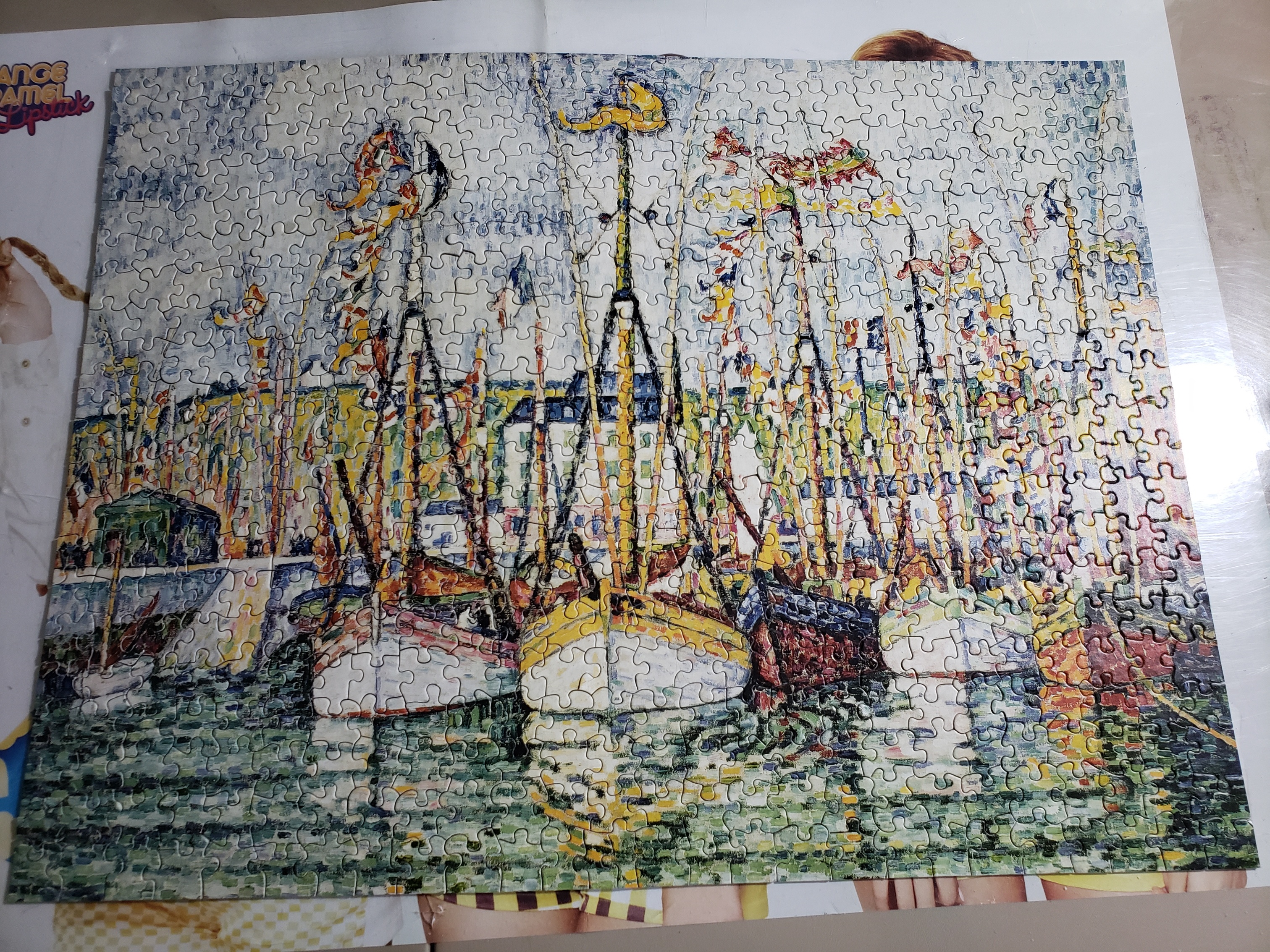
A friend of mine was questing for a puzzle the other day, turning up none after combing of her locale. I sent her an eBay link for the one I just completed, Paul Signac’s “Blessing of the Tuna Fleet at Groix,” brought to us by The Minneapolis Institute of Arts and publisher Museum & Wildlife Collections. I very much took my time, snapping a photo from time to time.

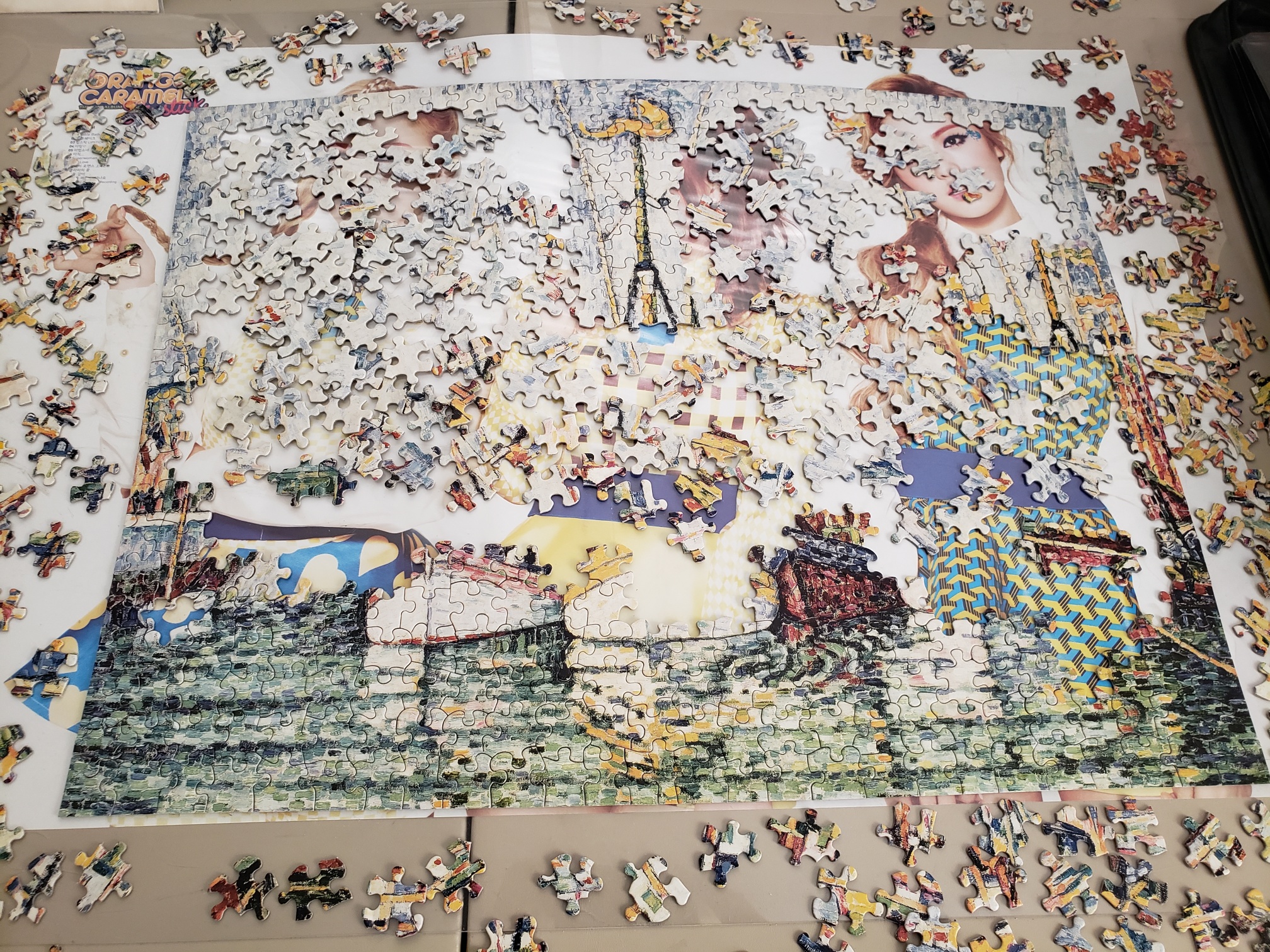
It all started in mid-November, building the border, and yes that’s Orange Caramel of “Lipstick” fame, a poster underneath a sheet of plastic. It was hard not to buy a CD when visiting Seoul without having posters and other ephemera thrust upon one. Cute.

111719-signac

11/17/19

My parents love puzzles these days, board games having been usurped, and my late uncle did them for many years, getting hooked on them during a hospital stayhe had a special affinity for 1,000 piece ones, which I find rather amazing.

Work progressed bit by bit, and a month later:

121819-signac

12/18/19

On two card tables in the second bedroom, I worked to music and a lot of singing resulted. It was a great way to enjoy my whole music collection. And I even fit some pieces together.

021120-signac

2/11/20

In mid-March, a certain album revealed itself to me in a depth I’d never noticed as rapid progress was made.


This slideshow requires JavaScript.

Until all was complete:

031920-signac-done

3/19/20

How satisfying! It’s hard to imagine wanting to do a different puzzle. This one is perfect, with insight into classic art in an Impressionist, semi-Pointillist style where each piece sheds light on the artist’s loving detail, plus the pieces are cut in a huge variety, so it’s exciting to track them down and piece them together. I’ll probably take some board games for a spin next, but I am tempted to just take the puzzle apart and then start all over again!

Read Full Post »

The time has come again.

I’ve been watching lots of Women’s World Cup soccer action, and figure it is about time. Watching these women play with gusto and expertise hearkens me back to my days playing the same sport, and subsequent efforts in tennis, softball, basketball, and epic pick-up football struggles with friends–but those days for me are no more, even were I to pick sports back up. I have taken a different path, a more bookish one, and I figure I ought to make the most of it rather than look wistfully at other options. So, days of sucking orange slices with comrades in arms may be gone, but we press on.

Lavelle-World-Cup-750x500

Lefties unite! Rose Lavelle left foots it.

A lot of my previous writing was as assigned, always an easy task when given limits, or “because a fire was in my head.” Thanks to these and some other endeavors (see About for a few) I’ve scraped together something of a corpus. As years and un-begun projects stack up, though, it is a good time to start in greater earnest, perhaps with a bit of refinement-through-age helping me, although this is hardly the brevity I was hoping for when I began typing this morning.

This blog is about music, and more. Art exhibits I visit, philosophic and political ideas that rear their heads, favorite works of literature, historical oddities, movies, aesthetic miscellanies, etc. And this all started and starts with The Sugarcubes. A decade or more ago, a workplace intern told me she was a fan of Björk (Guðmundsdóttir), renowned Icelandic solo singer, and presented me with a collection of her best work. When I mentioned Björk’s early group of some distinction, The Sugarcubes, she hadn’t heard of them. Of course, this saddened me.

Now, quite possibly a generation removed from those who have any acquaintance with Björk, let alone The Sugarcubes, I figure one thing I can share for any who are to read is my experience with music, something I have delved into with natural, unthinking avidity for my whole life.

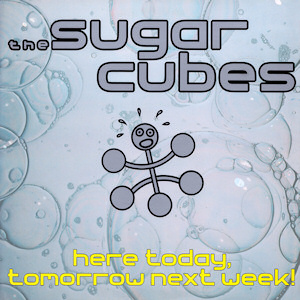
But the idea for this blog starts with The Sugarcubes, specifically their second album, Here Today, Tomorrow Next Week! This album is and was unsung, considered a disappointment at the time among the critics and my friends, my alternative set of friends as opposed to the rap one; another in the catalogue (yes, we can still spell it this way) of supposedly cursed debut follow-ups.

Here_Today,_Tomorrow_Next_Week!

©1989, Elektra Records

I didn’t know the release date, which turns out to be September 1989. What a wonderful date! My birthday month and the start of my college career! I was off in a place away from my altie music friends, but saw them plenty during Christmas break and summers, and we even exchanged written and posted letters often discussing these very things, music releases that is! So, with those days in mind, I will see what I can make of this blog today, tomorrow, next week.

Read Full Post »

« Newer Posts